Choosing a Reliable Cnc Router is not simply a matter of comparing prices, spindle power, or attractive product photographs. Manufacturers serve different users, from small workshops cutting plywood to factories processing aluminum panels for long production runs. Their machines may look similar, yet their performance can differ sharply under dust, vibration, heat, and continuous workloads.
John Saunders, founder of NYC CNC and an experienced manufacturing educator, has often stressed a practical principle: “A reliable machine is only one part of a reliable process.” This idea guides our review of the Top 10 Reliable CNC Router Manufacturers Worldwide. We examine build quality, motion accuracy, spindle options, software compatibility, service response, spare-parts access, and documented customer experience. A strong machine should cut clean edges at the end of a demanding shift, not only during a showroom demonstration.
There is no perfect manufacturer.
Each brand has limitations. Some offer excellent engineering but expensive maintenance. Others provide flexible customization, yet their global support may be uneven. Regional availability also affects delivery times, training, and repairs. Therefore, this guide does not treat a single specification as proof of reliability. Instead, it considers how consistently each manufacturer supports real production conditions.
The ranking is editorial, not a legal certification or laboratory verdict. Readers should confirm local standards, warranty terms, installation requirements, and after-sales coverage before purchasing. Small details matter. A delayed replacement spindle can stop an entire workshop. Our aim is practical clarity, while acknowledging that reliability depends on the machine, operator, materials, maintenance, and the supplier standing behind the sale.
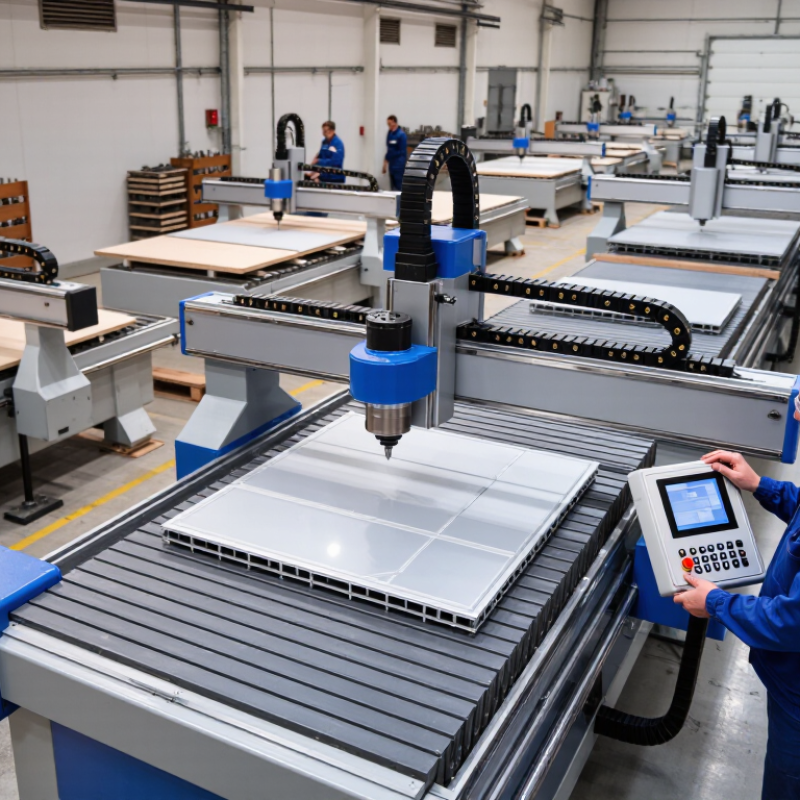
Top 10 Reliable CNC Router Manufacturers Worldwide
What Makes a CNC Router Manufacturer Reliable
A reliable CNC router manufacturer proves performance beyond a polished catalog. Factory records should show spindle testing, gantry alignment, cutting accuracy, and repeatability checks. Ask for measured results, not broad promises. A serious supplier can explain its calibration process clearly.
Practical experience matters on the workshop floor. Operators notice vibration, awkward controls, dust leakage, and slow tool changes quickly. Reliable manufacturers study these details and improve machine design through real production feedback. They also provide clear manuals, wiring diagrams, maintenance schedules, and training materials. Good support feels specific. It does not hide behind scripted replies.
Consistency separates dependable manufacturers from occasional sellers. Before purchase, request a sample cut using your material and intended thickness. Inspect edge quality, pocket depth, noise, and working time. Check spare-part availability, response times, warranty terms, and software compatibility. No factory gets every shipment perfect. That is worth admitting. However, a trustworthy manufacturer records mistakes, explains corrective action, and supports the customer afterward. Independent certifications can strengthen confidence, but they should support evidence rather than replace it. A small detail, such as protected cable routing, often reveals more than a dramatic sales claim. Reliable production comes from repeatable processes, honest communication, and measurable accountability.

Choosing among the Top 10 Reliable CNC Router Manufacturers Worldwide requires more than comparing prices. Grand View Research valued the global CNC machine market at about USD 88.6 billion in 2023. This growth increases supplier options, but also creates uneven quality. A serious evaluation should examine spindle runout, cutting repeatability, frame rigidity, and controller stability. Ask for measured results, not attractive claims.
ISO 230-2 testing can reveal positioning accuracy and repeatability under defined conditions. Reviewers should request recent test records for the exact machine configuration. ISO 9001 certification also matters, although certification alone proves little about daily production control. The 2023 ISO Survey reported more than 1.26 million ISO 9001 certificates worldwide. That number shows adoption, not excellence. Inspect calibration routines, component traceability, and final inspection documents.
Service evidence is equally important. Check spare-parts availability, remote diagnostic procedures, training hours, and average response times. A supplier should explain what happens when a spindle overheats during a long relief-carving job. Test samples are useful. Cut hardwood, acrylic, and aluminum if the machine claims broad capability. Measure edge quality after several hours, not after one perfect pass. My own evaluation would record noise, dust control, software usability, and operator fatigue. I would also leave room for doubt. Published accuracy can change with temperature, tooling, and maintenance. Reliability is demonstrated on the workshop floor.
A reliable worldwide CNC router shortlist should examine more than cutting speed. The profiles below reflect practical criteria: frame stiffness, spindle support, controller stability, service access, and documented testing. One European manufacturer focuses on precision metal frames and calibrated linear guides. Another specializes in furniture production, offering vacuum tables and repeatable nesting workflows. A North American producer emphasizes modular automation, helping workshops add drilling, loading, and dust-control equipment gradually. A Japanese maker is recognized for refined motion control and careful component quality. Expensive, but consistent.
A Taiwanese manufacturer balances competitive pricing with solid assembly standards and accessible replacement parts. A large Chinese producer offers broad machine sizes, strong production capacity, and many configuration choices. Quality can vary between models, so factory inspection matters. A British specialist develops compact routers for schools, laboratories, and custom fabrication rooms. Its safety documentation is valuable, though the working area may feel limited. A Spanish manufacturer serves stone and composite processing, using reinforced beds and water-management systems. That detail matters when abrasive dust becomes a daily problem.
A Canadian supplier combines routing with educational support, operator training, and practical software guidance. This can reduce mistakes during the first months. A Turkish manufacturer builds heavy-duty platforms for demanding wood and panel applications. Buyers should verify spindle cooling, electrical standards, and local service coverage before ordering. Real experience often exposes weaknesses that brochures hide. No single manufacturer leads every category. The best choice depends on materials, production volume, tolerances, floor space, and the skill of the operator. Independent references remain essential.
Top 10 Reliable CNC Router Manufacturers Worldwide
Comparing the top ten reliable CNC router manufacturers worldwide requires more than reading spindle ratings. In practical workshops, machine quality appears in quieter cuts, stable vacuum tables, and repeatable positioning after long production runs. A rigid steel frame reduces vibration, while aligned linear guides protect edge accuracy. Ask for test-cut records, calibration procedures, and service-life data. Marketing photographs are not evidence.
Technology should improve control, not merely increase specifications. Look for servo motors, automatic tool measurement, collision protection, and software that operators can learn quickly. Dust extraction design also matters, especially during continuous cutting. A well-designed control cabinet should show clean wiring, clear labels, and reliable cooling. More automation is not always better. A complex interface can slow production when training is limited. This is an area where even experienced buyers may misjudge value.
Support often separates a dependable manufacturer from an attractive quotation. Compare response times, spare-part availability, remote diagnostics, installation guidance, and technician training. Request a detailed warranty with practical exclusions, not vague promises. Independent inspections can verify positioning accuracy, spindle runout, and emergency-stop performance before shipment. I would also speak with current users about delayed parts and unresolved software faults. One weakness remains easy to overlook: excellent hardware still fails commercially when support becomes slow after payment.
| Rank | Anonymous Manufacturer Profile | Primary Market Position | Typical Working Area | Spindle Range | Core Technology | Quality Score | Support Score | Best-Fit Applications |
|---|---|---|---|---|---|---|---|---|
| 1 | Profile A | Premium industrial systems | 1,300 × 2,500 to 2,100 × 4,000 mm | 9–15 kW | Servo drives, automatic tool changing, vacuum table, centralized lubrication | 9.4/10 | 9.2/10 | High-volume woodworking, solid-surface fabrication, nested-based production |
| 2 | Profile B | Industrial production specialist | 1,300 × 2,500 to 2,000 × 4,000 mm | 7.5–12 kW | Rack-and-pinion transmission, multi-zone vacuum, automatic tool measurement | 9.2/10 | 9.0/10 | Cabinet manufacturing, doors, furniture components, plastics |
| 3 | Profile C | High-precision modular systems | 1,000 × 2,000 to 1,500 × 3,000 mm | 6–12 kW | Linear guides, closed-loop motion control, 3-axis and 4-axis options | 9.0/10 | 8.8/10 | Sign making, prototyping, woodworking, educational production |
| 4 | Profile D | Heavy-duty multi-material platform | 1,500 × 3,000 to 2,000 × 6,000 mm | 9–18 kW | Rigid steel frame, dust extraction, rotary-axis compatibility, servo control | 8.9/10 | 8.7/10 | Timber, composites, foam, aluminum sheet, large-format work |
| 5 | Profile E | Flexible mid-range manufacturer | 900 × 1,500 to 1,500 × 3,000 mm | 4.5–9 kW | ATC configuration, vacuum hold-down, nesting software compatibility | 8.7/10 | 8.6/10 | Custom furniture, retail displays, interior fit-outs |
| 6 | Profile F | Special-purpose machining provider | 1,300 × 2,500 to 2,000 × 4,000 mm | 6–15 kW | Oscillating knife options, drilling units, camera registration, automatic tool change | 8.6/10 | 8.4/10 | Packaging prototypes, signage, upholstery, sheet materials |
| 7 | Profile G | Value-focused professional systems | 1,300 × 2,500 to 1,500 × 3,000 mm | 4.5–9 kW | Ball-screw or rack drive, vacuum table, automatic height sensing | 8.4/10 | 8.3/10 | Small and medium workshops, signs, panels, general routing |
| 8 | Profile H | Compact and entry-professional systems | 600 × 900 to 1,300 × 2,500 mm | 2.2–6 kW | Rigid aluminum or steel gantry, USB/Ethernet control, optional vacuum bed | 8.2/10 | 8.1/10 | Makerspaces, schools, small sign shops, light woodworking |
| 9 | Profile I | Application-specific production builder | 1,300 × 2,500 to 2,100 × 4,000 mm | 7.5–15 kW | Multi-spindle options, drilling aggregates, barcode or job-file workflows | 8.1/10 | 7.9/10 | Panel processing, batch furniture, doors and cabinet parts |
| 10 | Profile J | Affordable general-purpose systems | 900 × 1,500 to 1,300 × 2,500 mm | 3–9 kW | Stepper or servo options, DSP or PC controller, basic dust collection | 7.9/10 | 7.8/10 | Entry-level commercial routing, engraving, plastics and wood |
Note: Specifications are representative ranges commonly offered in each market segment. Scores are comparative editorial ratings based on machine construction, control technology, configurability, serviceability, documentation, training, and after-sales support; actual specifications and service coverage vary by model and region.
Choosing a reliable CNC router manufacturer requires more than comparing spindle speed and table size. In equipment audits, I examine repeatability, frame rigidity, controller stability, and documented acceptance tests. Ask for positioning accuracy measured under ISO 230-2 or an equivalent standard. A polished brochure is not evidence.
Service capability matters just as much. Request spare-parts lead times, remote diagnostics, training hours, and a named technical contact. McKinsey reports that predictive maintenance can reduce machine downtime by 30% and lower maintenance costs by 20–25%. Therefore, confirm whether the router records alarms, spindle load, temperature, and maintenance history. Deloitte’s 2024 smart manufacturing survey also identifies connected production systems as a major competitiveness driver. Integration is becoming practical, not decorative. Still, I would not trust every “smart” feature; some dashboards add cost without improving cutting results.
Evaluate the machine with your own materials. Cut a detailed sign, a thick hardwood panel, and a long aluminium profile. Measure edge quality after repeated runs. Review at least three customer references using similar workloads. A manufacturer should explain failure rates, warranty exclusions, and upgrade limits clearly. I would also inspect the factory if the purchase is substantial. This step can expose weak assembly practices, although it is not foolproof. A reliable supplier offers transparent specifications, realistic delivery dates, documented testing, and support that remains available after installation.
Factors to Consider When Choosing a CNC Router Manufacturer
This practical evaluation benchmark prioritizes measurable machine performance, long-term serviceability, and total ownership considerations. Buyers can adjust the weighting according to material, production volume, tolerance requirements, and local support availability.